

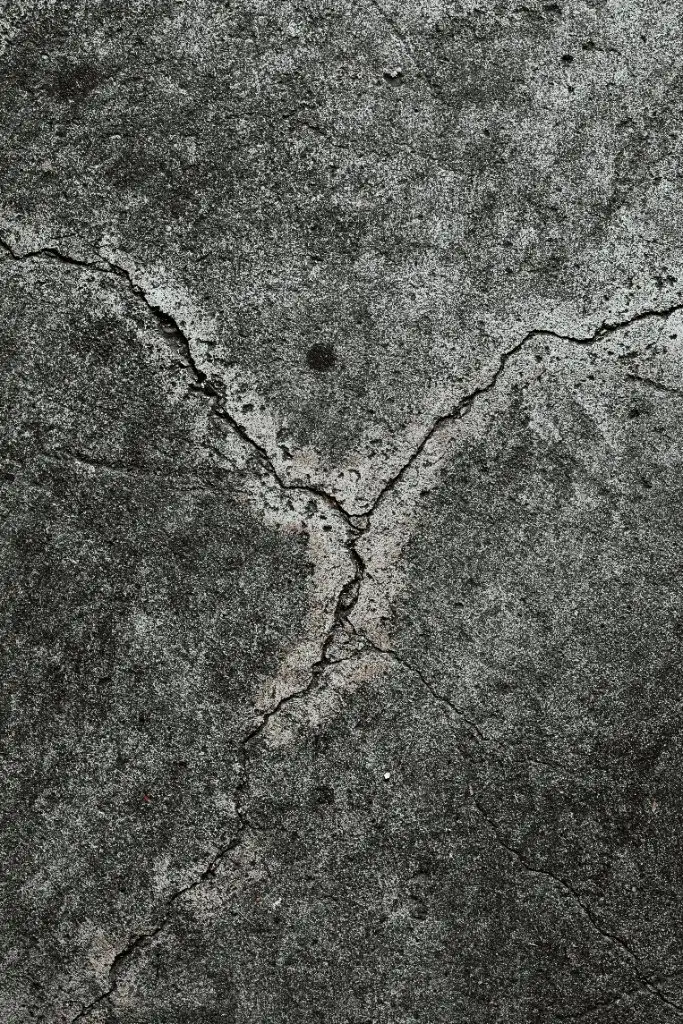
Concrete looks permanent and behaves like a sponge. It is porous by design, and almost everything that shortens its life arrives through those pores.
A sponge with a stone skeleton
Concrete is aggregate held together by cement paste. As the paste cures it loses water and forms a network of capillaries: millions of tiny connected channels through the slab.
Those channels are why concrete breathes, and they are also the road every de-icing salt, oil drip and freeze-thaw cycle takes into the material.
Carbonation
Carbon dioxide in the air reacts with the cement paste over time, lowering its alkalinity. That is normal and slow on the surface, but it makes the outer layer more brittle and less able to protect anything embedded in it.
Carbonation moves fastest where the surface is porous and exposed, which is why a sealed driveway ages differently from an untreated one.
Freeze-thaw, the main event in cold states
Water that has entered the pores expands when it freezes. Repeated cycles push at the paste from the inside until small flakes lift off the surface, which is the scaling most homeowners see first.
Repairing the flake does not fix the cause. Reducing how much water enters is the part that changes the timeline.
Salt, oil and the domestic load
De-icing salt draws water into the slab and crystallises inside it. Oil and fuels break down the surface layer where they pool. Neither is dramatic, and both are cumulative.
A surface that repels water slows all of it at once, because each of these problems starts with something soaking in.
What can and cannot be fixed
Protection is for concrete that is still structurally sound. Cracks, spalling and settled slabs are repair work and come first.
The assessment checks for that before recommending a treatment, so you are not sealing a slab that needs fixing.
Source
Written for Dr. Armor. The original GoNano article this guide draws on: The science behind concrete aging and deterioration
Questions
Common questions, answered in full
- How long does roof rejuvenation last?Coverage runs from 3 to 20 years, and the roof’s condition score decides which.
- Can you treat a roof that is leaking?No. A leak is a repair job and has to be fixed before any treatment.
- What does the warranty cover?Peeling, curling or warping caused by the treatment, and water getting through.